Choosing a CRM (Customer Relationship Management software) is a key step in an SME’s digitalisation. Should you opt for standard, ready-to-use software or consider a custom solution?
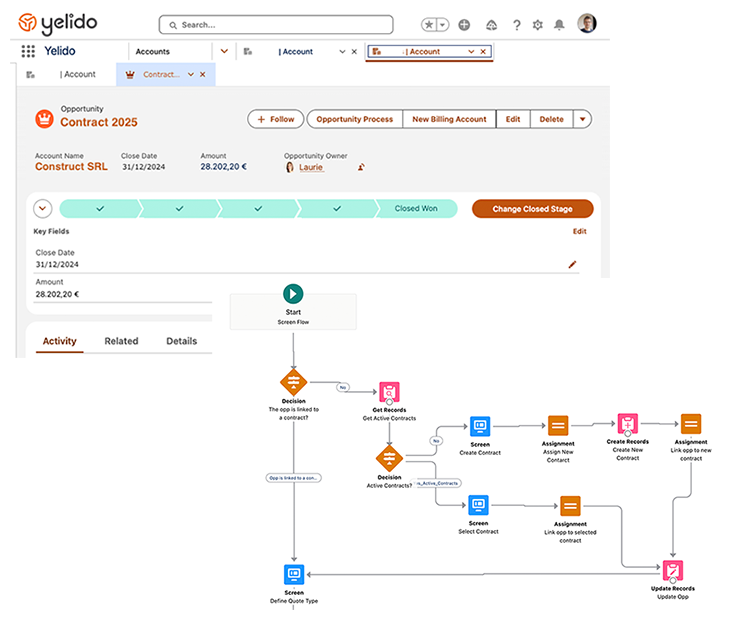
While standard software can be suitable in some cases, a custom CRM quickly becomes a strategic choice for any company that wants a tool fully aligned with its processes and priorities.
The benefits of a custom CRM
A custom CRM stands out above all for its ability to reflect the reality of your business instead of forcing you to adapt your processes to generic software. The concrete benefits are many:
- Business alignment: the software matches your working methods exactly (sales follow-up, quote management, reporting, etc.).
- Easier adoption: your staff recognise their own way of working in the tool and find it suited to the device they use, which limits resistance to change.
- Targeted scalability: a custom CRM can grow with you, by adding specific modules over time.
- Clear return on investment: less re-keying, fewer errors, more time spent with your customers.
Rather than an imposed tool, it is a real driver of productivity and peace of mind for your teams.
When does a custom CRM become essential?
Not every company needs a custom CRM from the outset. But some contexts make this choice unavoidable:
- Complex business rules: for example, a company that must apply several levels of approval or specific pricing.
- Rapid growth: when a company grows very quickly, standard software soon reaches its limits.
- Multiple integrations: if you need to connect the CRM to other tools (accounting, ERP, quality monitoring), a rigid system becomes a hindrance or even a blocker.
- Critical processes: as soon as the reliability of your sales follow-up or customer service determines your overall performance, adapting the tool to your needs is a necessity.
In these situations, a standard CRM patched together with workarounds becomes a source of frustration, whereas a custom CRM makes day-to-day work smoother and more secure.
The right level of customisation for your CRM
A custom CRM does not mean starting from scratch. The key is not to set “develop everything” against “use everything as standard”, but to find the right balance for each case.
A purpose-built toolbox can serve as a reliable and cost-effective foundation, while custom development provides the precision your specific processes require.
This balance is what makes a project succeed: a custom CRM that is quick to implement, financially under control and true to the way you work. This thinking takes place during the scoping phase, to define the “right level” of customisation that will deliver the most value to your SME and your business.
How to make your custom CRM a success with Yelido
At Yelido, we support Belgian SMEs in this process with a pragmatic, craftsman-like approach:
- Rigorous scoping: workshops to understand your processes, identify bottlenecks and define a realistic scope.
- An MVP (Minimum Viable Product) goal: a focused first version of your custom CRM, covering the essentials and able to evolve afterwards.
- Proven building blocks with our Orkkestra toolbox: our Billing, Quoting and TimeTrack modules speed up the implementation of features common to every company (quotes, invoicing, time tracking).
- A 100% senior team: no juniors learning on the job, but experts able to turn your needs into robust and elegant solutions.
- Regular demos: you see your custom CRM take shape step by step and can make adjustments in real time.
This methodology guarantees you a tool that truly fits your needs, without excessive development or wasted time.
A custom CRM is not a luxury but a strategic investment for any SME that wants to align its tools with the reality of its business. Its benefits are clear: easier adoption, greater efficiency and scalability over time.
With Yelido, a certified Salesforce integrator and application developer, you benefit from a local, experienced and pragmatic partner, able to find the right balance between existing building blocks and custom development for your specific use.
Explore Salesforce with Yelido:
- How to choose the right Salesforce agency?
- Salesforce implementation: making your project a success and avoiding the pitfalls
- Why choose Salesforce for an SME?
- Salesforce training: restoring the value of your CRM with tailored support
- The benefits of custom management software for an SME
- Yelido’s business-driven approach to any invoicing software for SMEs
- Quote and invoice software: a Salesforce module designed by Yelido