Electricity and gas supply, storage, grids, electric mobility: for more than ten years, we have been building the tools that keep the sector’s sales and technical teams running.

They trust us
Energy companies that already work with us


Where we work
Energy, a sector we know from practice
The energy market has its own rules, vocabulary and constraints. We know them because we have met them at our clients, across four different fields.
Capturing requests from every channel, qualifying prospects, managing a B2B pipeline, generating contracts and customer documents in the right language. We have done it for Mega on VTiger and for Codel on Salesforce, price fixations included.
Many energy businesses rely on complex calculations, stuck in spreadsheets or in the heads of a few experts. We know how to turn them into web applications that a whole team can use, with comparable scenarios, readable results and controlled access. Your calculation model remains yours: we build the tool around your expertise, never around someone else’s.
Teams working on site need tools that are simple, available and reliable. We support companies such as Veolia and Ampacimon with management solutions, integrations and cloud infrastructures designed to last.
Home charging, recharging costs billed back to the employer, consumption tracking: we have developed split billing solutions for charging stations and supported electric mobility players across the whole chain, from data to invoice.
What we build for the energy sector
Practical tools, delivered and used every day by sales teams, estimators and technicians.
References
Our references in the energy sector
 Volt-R
 develops a platform for sizing industrial batteries for the Belgian energy market. To turn sharp calculation expertise into a genuine web product accessible to its sales teams and its clients, Volt-R relied on Yelido to design and develop the application end to end: a multi-organization platform, built on a calculator developed by Volt-R’s own engineers, that simulates, compares and optimizes energy storage scenarios in just a few minutes.
Volt-R develops a platform for sizing industrial batteries for the Belgian energy market. To turn sharp calculation expertise into a genuine…
 Mega
Mega is a Belgian energy supplier that provides electricity and gas to businesses. To structure and centralize all of its B2B sales management, Mega relied on Yelido to implement a tailor-made VTiger CRM: a single tool that captures prospects from every channel, drives the sales cycle and connects to the company’s website and existing tools.
Mega is a Belgian energy supplier that provides electricity and gas to businesses. To structure and centralize all of its B2B sales manageme…
 Codel
Codel is a natural gas supplier active on the Belgian energy market. To professionalize the management of its contracts and price fixation operations, Codel relied on Yelido to design a tailor-made solution within Salesforce that automates the entire sales cycle, from the won opportunity through to the signed contract and the documents sent to the customer.
Codel is a natural gas supplier active on the Belgian energy market. To professionalize the management of its contracts and price fixation o…
 Ampacimon
 develops monitoring solutions for power grids, including sensors that estimate the capacity of high-voltage lines in real time. To follow and manage its sensor fleet, Ampacimon relied on Yelido to develop the web interface of its management application, M.U.I.
Ampacimon develops monitoring solutions for power grids, including sensors that estimate the capacity of high-voltage lines in real time. To…
 Unipso
 is a cross-sectoral federation that represents and supports social-profit enterprises. Day to day, its teams manage a large volume of contacts (institutions, federations, individuals) and training events. To replace a multitude of individual Excel files and professionalize this management, Yelido designed and developed SoDa (Social Data): a business web application backed by a centralized database, giving every team a single, reliable source of information, connected to Unipso’s website, emailing and messaging.
Unipso is a cross-sectoral federation that represents and supports social-profit enterprises. Day to day, its teams manage a large volume of…
 Euresys
 is a leading Belgian player in machine vision, specialising in the design and supply of image acquisition components, frame grabbers and image processing software. The company serves demanding markets such as electronics manufacturing, food inspection, medical applications and microscopy, with an international presence in EMEA, the Americas and Asia-Pacific.
Euresys is a leading Belgian player in machine vision, specialising in the design and supply of image acquisition components, frame grabbers…
 Knauf
Knauf wanted to develop a LoToTo (lockout, tagout, tryout) application to ensure the safety of machine maintenance operations. The tool developed by Yelido ensures that hazardous equipment is powered down and locked out prior to maintenance, thereby improving the safety and efficiency of operations through an intuitive digital solution that complies with industry standards. The app now enables real-time and post-event tracking of all maintenance operations to enhance safety for all personnel involved.
Knauf wanted to develop a LoToTo (lockout, tagout, tryout) application to ensure the safety of machine maintenance operations. The tool deve…
 Orkkestra
 is a 100% Salesforce-native billing and e-invoicing solution developed by Yelido and available on AppExchange. Designed for small and medium-sized businesses, it unifies the management of orders, subscriptions, billing, and e-invoicing compliance directly within the Salesforce ecosystem, without the need for external integrations or middleware.
Orkkestra is a 100% Salesforce-native billing and e-invoicing solution developed by Yelido and available on AppExchange. Designed for small …
 Listen
 is an independent Belgian market research and consulting firm. Its human-scaled structure allows it to operate with agility and offer tailored solutions to its clients. As its business grew, Listen sought to modernize and centralize the management of its sales processes within a single, scalable platform.
Listen is an independent Belgian market research and consulting firm. Its human-scaled structure allows it to operate with agility and offer…
 Tilman
 is a Belgian pharmaceutical company renowned for its herbal remedies and dietary supplements.
Yelido helped their teams to modernise its sales management system.
Tilman is a Belgian pharmaceutical company renowned for its herbal remedies and dietary supplements.
Yelido helped their teams to modernise …
 SMI-LE
The non-profit organisation SMI-LE (Service Mobile Infirmier Liégeois) has been active in Liège since 2021. With a dozen nurses, physiotherapists and psychologists, the team roams the streets of the city to help people in extreme poverty. The organisation aims to reduce morbidity and mortality rates on the streets by acting as a bridge between the streets and healthcare facilities.
The non-profit organisation SMI-LE (Service Mobile Infirmier Liégeois) has been active in Liège since 2021. With a dozen nurses, physiothe…
 Veolia
 is a French group that designs and implements solutions for water, waste and energy management. The group works in particular with local authorities and industries in Belgium, and it was in this local context that we met them.
Veolia is a French group that designs and implements solutions for water, waste and energy management. The group works in particular with lo…
 Université de Liège
SEGI is the IT department of the university of Liège and is responsible for the smooth running of IT systems at ULiège and the University Hospital. It also offers HRM solutions for public services, student management and a mobility solution.
Yelido has built or taken over several programmes for the SEGI or the University of Liège.
SEGI is the IT department of the university of Liège and is responsible for the smooth running of IT systems at ULiège and the University …
 Synerglass Soft
 is specialised in the digitalization and overall organisation of glass processing companies. Based on its experience in the field, Synerglass Soft offers its customers unique software and local services. Synerglass’s objective is clear: growth and internationalisation.
With this in mind, Synerglass initially called on Yelido to structure and digitise its sales department within the Salesforce ecosystem. This has enabled the sales team to work more effectively with centralised data.
Synerglass Soft is specialised in the digitalization and overall organisation of glass processing companies. Based on its experience in the …
 FARES
FARES is responsible for coordinating tuberculosis prevention and surveillance activities in the Walloon Region and the Brussels-Capital Region. It works with various social and healthcare stakeholders on projects to improve the care and follow-up of tuberculosis patients and to organise screening among people at risk. Members of its service can use our application in the field when meeting their public or during medical appointments.
FARES is responsible for coordinating tuberculosis prevention and surveillance activities in the Walloon Region and the Brussels-Capital Reg…
 Idewe
IDEWE contributes to creating a safe and healthy working environment for 35,000 employers and 822,000 workers. Yelido has been working with Idewe for many years and has followed the company’s development through various medical record tracking applications.
IDEWE contributes to creating a safe and healthy working environment for 35,000 employers and 822,000 workers. Yelido has been working with …
 V2i – Engineering
V2i is an engineering company offering a comprehensive range of bespoke services in the field of mechanical vibrations, with both theoretical and experimental expertise.
V2i is an engineering company offering a comprehensive range of bespoke services in the field of mechanical vibrations, with both theoretica…
 Oxfam – MDM
Oxfam-Magasins du monde brings together a network of volunteers who run shops selling fair trade products (food, crafts, cosmetics). Each sale helps to improve the lives of producers in the South and promote responsible consumption here in Europe.
Oxfam-Magasins du monde brings together a network of volunteers who run shops selling fair trade products (food, crafts, cosmetics). Each sa…
 Naturhome
 is a company specialising in the construction of high-end timber frame houses (Luxembourg/premium segment). Faced with the growth of its business, Naturhome was looking for a solution to centralise, track and control all data related to its projects, while ensuring a high-end customer experience.
Naturhome is a company specialising in the construction of high-end timber frame houses (Luxembourg/premium segment). Faced with the growth …
 TotalEnergies
A few years ago, the most popular service sold by TotalEnergies in the Netherlands was Vroaming Onderweg, the sale of an electric car charging card. Vroaming Onderweg was providing access to 110,000 charging points across Europe, including more than 50,000 public charging points in the Netherlands. The process for this product, from registration on the website to activation and delivery of the card, requires no manual intervention. This is why it makes sense to automate the process completely.
A few years ago, the most popular service sold by TotalEnergies in the Netherlands was Vroaming Onderweg, the sale of an electric car chargi…
Proximity. Authenticity. Expertise.
How a project runs with us
01.
90% of our team has worked in the sector
Why energy companies choose us
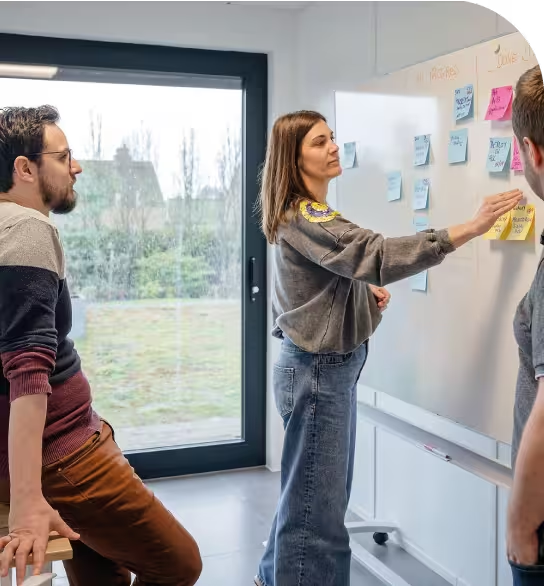
90% of our staff have worked in the energy sector. You come with a project, and you do not have to explain the sector to us: we already know the vocabulary, the constraints and how the market works.
- The vocabulary of energy mastered from the first meeting
- Tools that speak to your sales teams and your technicians alike
- The choice between Salesforce, an ERP or custom software, depending on what really serves you
- Budgets defined in advance and kept
- European hosting and serious security standards
- Stable contacts, there for the long term